AI Overviews vs AI Mode: What’s the Difference for Your Business?
Understand how Google’s AI search experiences differ and what each means for your business.

AI Overviews summarize information within Google Search results, while AI Mode supports deeper exploration through questions, comparisons, and follow-ups. For a business, the distinction is how customers discover and evaluate you. Check both experiences separately, but build one coherent website and content strategy rather than two competing versions of every page.
Key takeaways
- AI Overviews provide summaries within search results; AI Mode supports ongoing exploration.
- A business mention, a linked citation, and an enquiry are different outcomes.
- Useful service information supports both experiences without requiring duplicate pages.
- Compare repeat observations, verify the sources, and judge progress alongside qualified leads.
What is the difference between AI Overviews and AI Mode?
The main difference is the search experience, not a separate category of customer. An AI Overview offers a summary in the results page; AI Mode gives the searcher more room to investigate and refine a question. A person can move from an overview into AI Mode, so these are connected experiences rather than isolated channels.
Google’s AI Overviews guidance describes a snapshot with links that appears when Google considers it helpful. An overview is not guaranteed for every search. Google’s AI Mode guidance describes follow-up questions and deeper exploration supported by web sources. Both can make mistakes.
Use the comparison below to decide what to inspect. The examples are illustrative customer questions, not screenshots or results from a test.
| What to compare | AI Overviews | AI Mode |
|---|---|---|
| Starting experience | Summary within Google results, when shown | AI-powered search with follow-up exploration |
| Customer task | Get oriented and find useful sources | Compare options and refine requirements |
| Illustrative question | What should a roof inspection include? | Compare inspection options for a home before purchase |
| Next interaction | Explore a source or continue searching | Add constraints and ask another question |
| Business check | Is your page linked, or your business named? | What happens to sources and business descriptions across follow-ups? |
Avoid reducing this to ‘simple questions versus complex questions.’ Overviews can address complicated topics too. The practical distinction is the amount of exploration available to the customer, and what that customer needs next.
How could the difference affect a service-business enquiry?
A customer may learn about a problem before deciding which business to contact. Your content should help at both points: explain the decision, then make your service scope and next step easy to verify. Visibility without enough information to evaluate you leaves part of that job unfinished.
Consider a homeowner researching a roof inspection. An initial question might be ‘What does a roof inspection cover?’ A follow-up might add a home purchase, a location, a deadline, or a request for a written report. Those details change what would count as a useful answer.
For that business, a helpful service page would explain the inspection process, deliverables, service area, scheduling conditions, and exclusions. A separate guide could explain how to evaluate an inspection report. Two distinct resources are more useful than near-identical pages labeled ‘AI Overview SEO’ and ‘AI Mode SEO.’
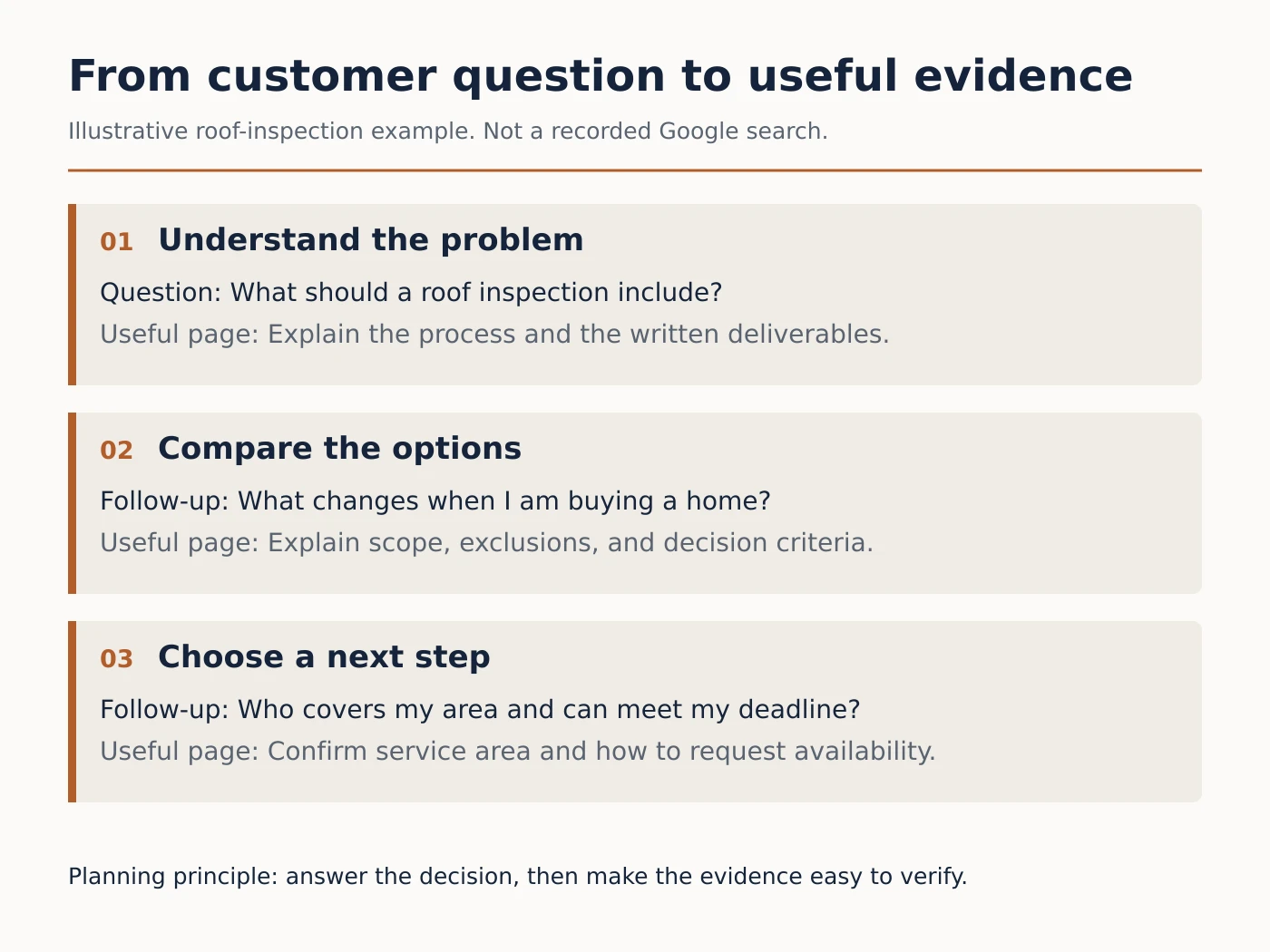
This is a planning example, not a claim that Google will recommend a particular provider or that this sequence always produces a lead. The original contribution is the decision map: connect the customer’s question to the evidence your website needs to provide.
Before adding another article, review whether your existing service pages help customers decide. Missing scope, confusing contact options, or unsupported promises can undermine an otherwise useful visit.
Why can your business appear in one experience but not the other?
The two experiences do not have to show the same sources. Google explains that their models and techniques can differ, so a citation in an AI Overview does not establish that the same page will appear in AI Mode.
Both may use query fan-out, meaning several related searches help develop an answer. Google’s technical guidance on AI features also says a supporting page must be indexed and eligible for a search snippet. Meeting those conditions does not guarantee inclusion.
When you inspect an answer, distinguish three observations: your business was named, your website was linked, or another website described your business. Those are different findings and may call for different actions. An inaccurate directory entry needs a different response from a useful service page that Google cannot index.
One absent citation is not enough to diagnose a technical problem. Record the exact question and context, inspect the linked sources, and repeat the observation before deciding what to change. Treat a competitor’s appearance as a research lead, not proof that copying its page will reproduce the result.
What should you improve on your website first?
Start with the pages a prospective client needs to make a decision. Make the information accurate, accessible, and specific to your actual service. My recommendation is to prioritize missing decision-making information before producing more general definitions of AI search.
- Check access. Confirm priority pages are indexable and reachable through internal links. Investigate an actual exclusion before assuming an AI-specific problem.
- Clarify the offer. State who the service is for, where it is available, what is included, and what happens after an enquiry.
- Show real evidence. Add approved examples, genuine qualifications, and process details that a customer can verify. Never substitute a generated image for a client result.
- Resolve conflicting details. Compare your website’s business name, service areas, and contact details with the profiles you control.
- Make the next step usable. Test the contact journey on a phone, including the form confirmation and notification delivery.
Google’s generative AI optimization guidance emphasizes valuable content and sound technical foundations. It also rejects special AI markup, arbitrary content chunking, and inauthentic mentions as shortcuts. There is no reason to turn every paragraph into a separate page.
For a wider plan, read why SEO and AI search belong in one strategy. My AI Search Optimization service connects that work to your business information, content, and technical priorities.
How can you check both experiences without misleading yourself?
Use a small, repeatable set of customer questions and keep the observations separate from business outcomes. I recommend a three-part check: Question, Evidence, Action. This is a practical worksheet structure, not a Google ranking formula or a claim about tested performance.
- Question: Choose one explanation question, one comparison question, and one provider-selection question relevant to your service. Keep their wording unchanged for repeat checks.
- Evidence: Examine each question in regular Google Search and AI Mode. Record whether an overview appeared, the exact linked URLs, business mentions, factual errors, and any follow-up wording. Save genuine dated screenshots.
- Action: Identify one justified next step per finding. Examples include correcting an outdated service description, clarifying a deliverable, or investigating an indexing issue. ‘Publish more content’ is not a diagnosis.
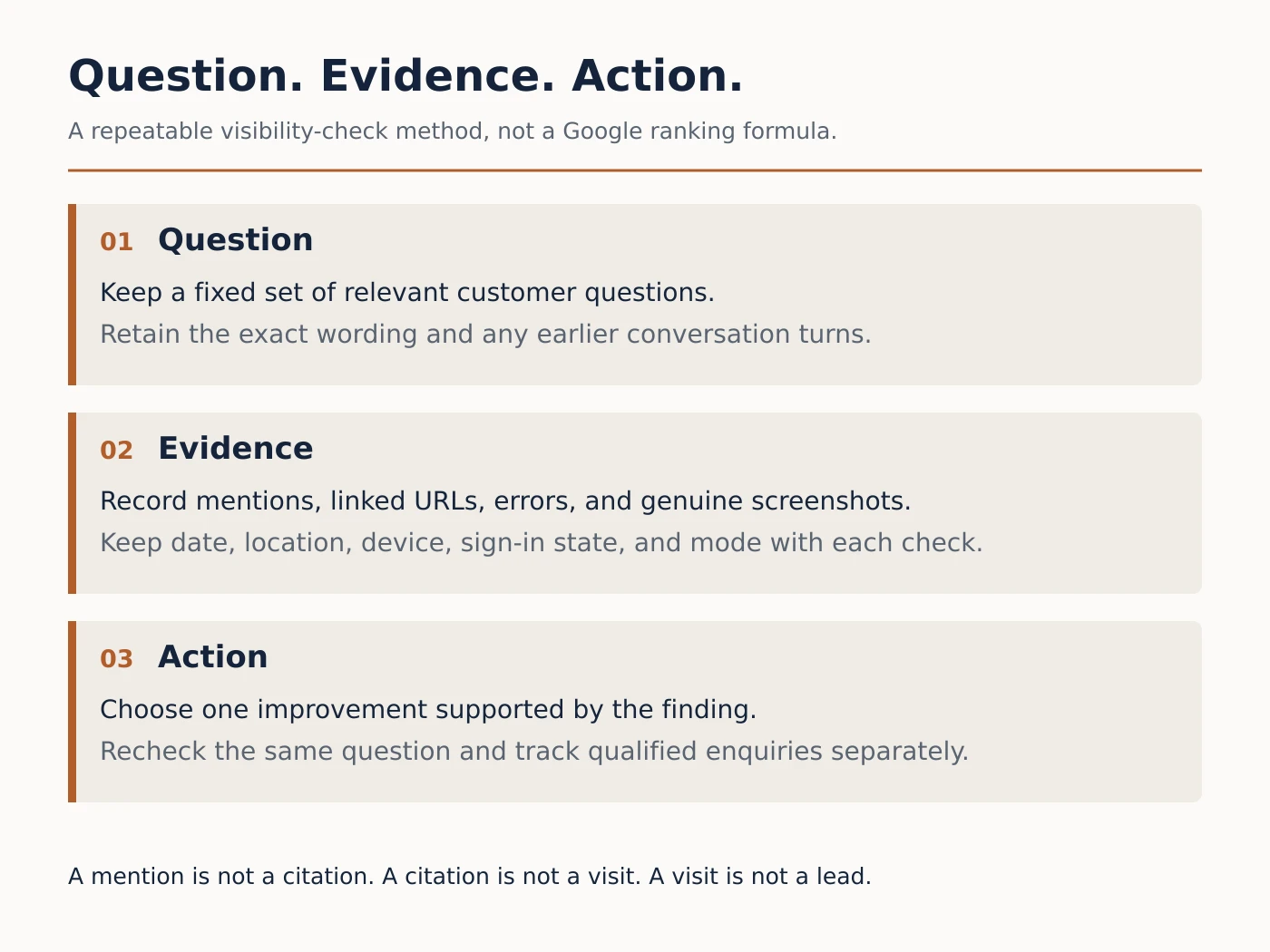
Record the date, location, device, sign-in state, and visible model or mode where relevant. For an AI Mode follow-up, retain the preceding question too. Without that context, two screenshots may reflect different searches rather than improvement or decline.
Do not count ‘no overview shown’ as ‘our competitor beat us in an overview.’ Those are different observations. Likewise, an unlinked name mention is not a website visit, and a citation is not a booked job.
If you want help choosing what to record, see what an AI visibility audit should deliver. A useful audit exposes its evidence and limitations, not just a score.
What should you measure besides mentions and citations?
Measure whether relevant people reach useful pages and become qualified enquiries. Keep a visibility log, search-performance reporting, and lead tracking alongside each other. None of those views alone tells the whole story.
Check the reporting available in your Search Console property rather than assuming that every Google visit has a clean AI Mode or AI Overview label. Google’s current documentation describes AI traffic in Web performance reporting and also points to a Generative AI performance report. Verify the report’s scope and definitions before making a comparison.
For your own review, record which landing pages receive enquiries, which services those enquiries concern, and whether they are a good fit. A month with more mentions but no relevant visits needs investigation. A month with fewer visits but stronger enquiries needs a different conversation.
Do not attribute every traffic change to AI answers. Compare the affected pages and queries, consider seasonality and site changes, and look for supporting evidence. Use your own search and enquiry data to assess the impact on your business; an industry-wide traffic-loss percentage cannot explain what happened to your website.
Frequently asked questions
Does AI Mode always provide an AI answer?
No. Google says AI Mode may show web links when it lacks enough confidence in an AI response’s quality or usefulness. That is another reason to inspect the actual result instead of assuming every search produces the same answer format. Save what appeared, not what you expected to appear.
Does a citation mean Google endorses my business?
No. Treat a citation as a link supporting an answer, not as a certification of service quality. Check what the source actually says and which part of the response it supports. A page explaining an inspection process may be cited without the answer recommending the company that published it.
Should I create separate pages for each experience?
Usually not when the customer’s question and the answer are the same. Start with one useful page and improve its coverage where needed. Create another page when it serves a genuinely different task, such as explaining inspection costs versus describing how to book your inspection service.
Can an agency guarantee that my site will appear?
No provider should promise inclusion in a particular AI answer. Google explicitly states that meeting its requirements does not guarantee indexing or serving. Ask a provider to commit to clear deliverables, documented checks, and an honest report of what changed, rather than a guaranteed citation or position.
What is the right next step for your business?
Start by checking a few real customer questions and the pages that should answer them. Use the findings to choose a specific improvement, then check again. The aim is to understand where your business is represented accurately and where a prospective customer still needs better information.
If you want a documented starting point, explore the $500 AI Visibility Audit. The current offer covers one website and a defined prompt sample across four named platforms, with delivery in five business days after payment and completed intake. Confirm the scope first, including any request to assess AI Mode separately.
About the author
Muhammad Faheem is the founder of Shayan Faheem SEO and an SEO & AI Search Specialist with more than 10 years of experience. He works with local service and multi-location businesses, connecting search strategy, content, and website implementation. His full name is Muhammad Shayan Faheem.
PUT IT INTO PRACTICE
Know where your business stands.
The AI Visibility Audit turns a defined set of customer questions into a practical improvement roadmap.