How Does AI Search Find and Cite Website Content?
Understand how your website becomes a source for AI answers, and what to check when it does not appear.

AI search can find website content through web crawlers and search services, retrieve information relevant to a question, and use it to build an answer with supporting links. Discovery, retrieval, and citation are separate steps. A page can be accessible or indexed without appearing in a particular answer.
Key takeaways
- Being found, being used, and being cited are different outcomes.
- Search access and model-training access are not the same setting.
- Specific, accurate explanations are more useful than generic claims.
- Check the source behind a citation and measure business mentions separately.
- Improve the page for the customer question, then repeat your checks.
How does AI search turn website content into an answer?
When an AI assistant uses web search, it can look for information relevant to a question and use that material to help construct an answer. The links you see are the visible part of that process, not a complete record of every page considered.
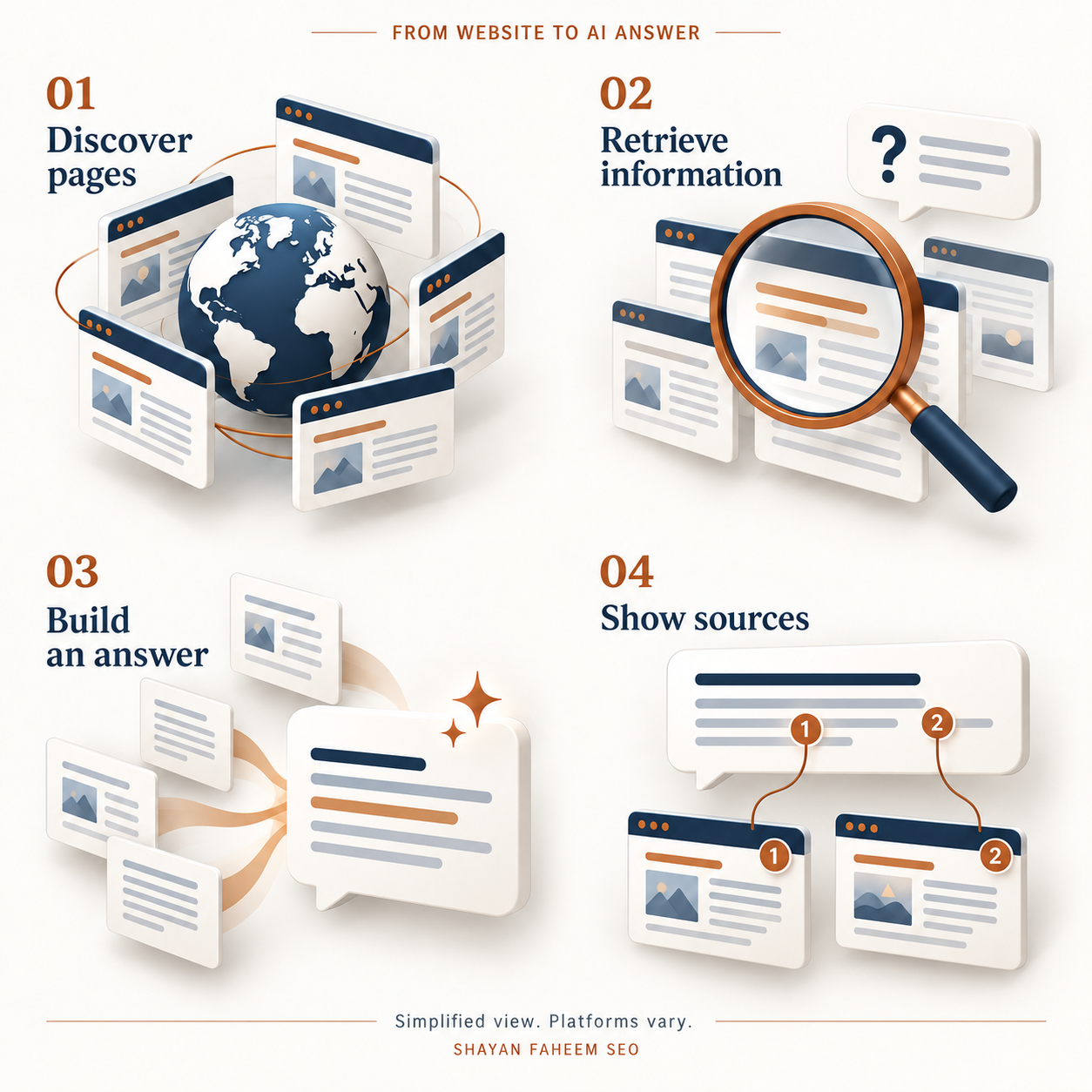
A useful way to understand it is through four stages. Discovery makes pages available to a search system. Retrieval brings back information for a particular question. Answer generation turns information into a response. Citation connects parts of that response to sources a reader can inspect.
These stages are a simplified model, not a universal specification. A system may run several searches, revisit a question, or combine different sources. The important business distinction is that being accessible does not mean being selected, and being selected does not guarantee a visible link.
Think of a prospective customer asking whether a heat pump suits an older home. A useful answer might need installation constraints, electrical requirements, and information about the property. One broad service page may not answer every part of that question.
How do search systems discover your pages?
Start with whether the relevant system can reach the page. A useful article cannot help a web-search system that is blocked from accessing it, and a working page in your browser does not establish that crawlers can access the same content.
For Google’s AI search features, a supporting page must be indexed and eligible to appear with a snippet. Google’s guidance for AI features and websites says there are no additional technical requirements, special AI files, or special schema needed.
For ChatGPT search, OpenAI distinguishes OAI-SearchBot from GPTBot, which concerns model training. Its crawler documentation explains that these controls are independent. You can allow the search crawler while disallowing the training crawler. Check firewall rules as well as robots.txt before assuming a crawler has access.
- Confirm the page opens without a login, error, or security challenge.
- Check indexing and canonical signals for the search engine you are investigating.
- Link to important articles from relevant pages instead of leaving them isolated.
- Make essential explanations available as readable text, not only inside images.
For a broader implementation check, use the technical SEO checklist for small-business websites. Access is the foundation, but it is only the first part of the problem.
How does AI search decide what information to retrieve?
Retrieval is question-specific. The useful source for “what does a roof inspection include?” may be different from the useful source for “does an inspection include a written report and repair estimate?” Those questions share a subject, but they need different evidence.
Google says AI Overviews and AI Mode may use query fan-out: multiple related searches across topics and data sources. They may also use different models and techniques. That helps explain why their supporting links can differ. The AI Overviews vs AI Mode comparison covers the customer-facing differences.
OpenAI’s ChatGPT search guidance says a question may be rewritten into targeted search queries, with further searches following initial results. A conversational question is therefore not necessarily sent to a search provider word for word.
For your content, I recommend starting with the decision behind the question. If a customer needs to know whether a service covers a particular situation, explain the conditions, exclusions, and next step. Repeating the service name throughout a page does not supply those missing facts.
Consider a hypothetical roof inspection page. “Comprehensive inspections by experienced professionals” says little about the deliverable. A specific explanation of what is examined, whether photographs are included, and when a written report is provided gives a reader more to evaluate. Only include those details when they accurately describe your service.
Why does a page get cited, mentioned, or left out?
A citation is a link attached to an answer or available through its source interface. A mention is simply a reference to your business or brand. Neither necessarily means the assistant has recommended hiring you.
The distinction matters when measuring progress. An answer could name your company while linking to a directory. It could cite your educational guide without naming your business in the main response. It could also cite a page that does not actually support the nearby claim. Open the source and check the connection.
| What you observe | What it establishes | What to check next |
|---|---|---|
| Your business is named | A brand mention in that answer | Is the description accurate, and where did the information come from? |
| Your website is linked | A visible link to your page | Does the page support the associated statement? |
| A third-party page about you is linked | That external page is a visible source | Is its business information current and correct? |
| Your page is indexed but absent | Indexing has not produced a citation in this observation | Does the page answer this exact question, and what sources were used instead? |
Do not turn one missing citation into a diagnosis. The question may call for information your page does not provide. The answer may use another relevant source, or the visible links may vary between attempts. Public documentation does not provide a complete formula that lets a business predict or guarantee selection.
I treat a citation as evidence to examine, not a score to celebrate on its own. The useful questions are whether the answer represents your business accurately and whether the linked page helps a potential customer take the next step.
What makes your content more useful as a source?
Build pages that can answer real questions clearly and support their claims. That is a sound editorial standard whether the visitor arrives through a search result, an AI answer, or a referral.
- Answer the question before expanding it. Give the reader the central explanation, then add conditions, examples, and limitations.
- Keep related information together. Put a service’s inclusions, exclusions, and process where a customer can compare them without guessing.
- Make claims verifiable. Link to the original documentation for technical statements. Use genuine findings, screenshots, or client evidence where you have permission.
- Separate fact from judgment. Explain why you recommend a course of action instead of presenting a preference as a platform requirement.
- Clarify responsibility. Identify the author, business, and relevant expertise consistently. Keep service information and contact details current.
- Connect the next useful page. Link an explanation to a relevant service, deeper guide, or documented example.
Avoid rewriting every section as a short answer box or adding FAQs that repeat the article. Formatting should help the reader understand the subject. It cannot compensate for vague information or unsupported claims.
This is why SEO and AI search belong in the same strategy. Maintain one useful website, then investigate the access and visibility differences of each platform.
How can you investigate why your website is not cited?
Start with a small set of questions your customers actually ask. Include an educational question, a service comparison, and a question about choosing a provider. Test each in the platform you want to understand, using its web-search experience where available.
- Record the conditions. Save the exact question, platform, date, relevant location, and any follow-up messages. Keep a copy of the answer.
- Separate the outcomes. Record business mentions, links to your domain, and links to third parties as different observations.
- Inspect the linked pages. Identify the specific information they contribute. Do not assume their length, headings, or design caused their selection.
- Check your intended page. Is it accessible? Does it answer the same question? Is important information missing or out of date?
- Choose one justified improvement. Fix an access issue, correct a factual gap, or improve a confusing explanation. Repeat the observation without treating one changed answer as proof of causation.
Suppose a competitor’s page is cited for a question about inspection reports, while yours only describes inspections generally. Adding accurate information about your report is a useful improvement. It is not proof that a particular heading or word count will earn the next citation.
Keep this work connected to business outcomes. A correct citation can be encouraging, but relevant visits, enquiries, and qualified leads help establish whether visibility is contributing to the business. If you need help interpreting the evidence, review what an AI visibility audit should deliver.
Questions about AI search and website citations
Does allowing AI training make my website more likely to be cited?
Do not treat training access as a citation requirement. OpenAI provides separate controls for GPTBot and OAI-SearchBot. Decide your training policy separately from whether you want your pages accessible to ChatGPT search.
Does ranking first on Google guarantee an AI citation?
No. A conventional result position is not a promise of a citation in a particular AI answer. Investigate the actual question and linked sources instead of using your ranking as a substitute for checking the answer.
Do I need a separate page for every conversational question?
No. Related questions often belong on one well-organized page. Create a separate article when it serves a genuinely different purpose and needs its own explanation, not simply because a prompt can be phrased another way.
Can I make an AI assistant cite my website?
You can improve access, accuracy, and usefulness. You cannot control the sources a platform selects for every answer. Be cautious of services that promise a specific citation without explaining the limits of that promise.
Start with the page your customer needs
Choose one important customer question and the page that should answer it. Check access first, then assess whether the explanation is specific, accurate, and supported. Compare what the AI answer actually says with what its sources establish.
My AI search optimization work focuses on turning those checks into practical priorities. The aim is a clearer, more useful business presence, not a collection of pages written only to chase citations.
About the author
Muhammad Faheem is the founder of Shayan Faheem SEO and an SEO & AI Search Specialist with more than 10 years of experience. He works with local service and multi-location businesses, connecting search strategy, content, and website implementation. His full name is Muhammad Shayan Faheem.
PUT IT INTO PRACTICE
Know where your business stands.
The AI Visibility Audit turns a defined set of customer questions into a practical improvement roadmap.