
How Long Does SEO Take for a Small Business?
Set realistic expectations, recognize meaningful progress, and know when a slow campaign needs a closer look.

SEO for a small business is best planned in months, not days, but there is no reliable deadline for rankings or leads. Individual improvements can show earlier; sustained results depend on your starting point, competition, implementation, and customer demand. Judge progress by completed work, relevant search visibility, and qualified enquiries rather than a promised date.
Key takeaways
- SEO timelines depend on your website, competition, and implementation speed.
- Completed work, search visibility, and qualified enquiries are different milestones.
- Review progress from the date changes went live, not just the contract start.
- A slow campaign needs a specific diagnosis, not an indefinite request for patience.
What is a realistic timeline for SEO results?
I recommend planning for several months of implementation and evaluation. Start with your website’s current performance and the business outcome you want to improve, then agree on milestones for reviewing progress. Expecting a dependable flow of leads in the first few weeks can lead to decisions before the work has had time to take effect.
Google’s SEO Starter Guide explains that individual changes can take hours to several months to affect search results. Google generally recommends allowing a few weeks before assessing a change and notes that some changes produce no noticeable improvement.
Those statements describe changes in search, not a deadline for recovering your investment. A page can become discoverable before it attracts suitable visitors, and suitable visitors may need time to become customers. Ask an SEO provider which outcome their estimate refers to: indexing, visibility, enquiries, or booked work.
For example, a local business with an established service page has a different starting point from a new company with no useful service content. Giving both the same six-month promise would hide the very differences a good assessment should explain.
What should happen before SEO produces more enquiries?
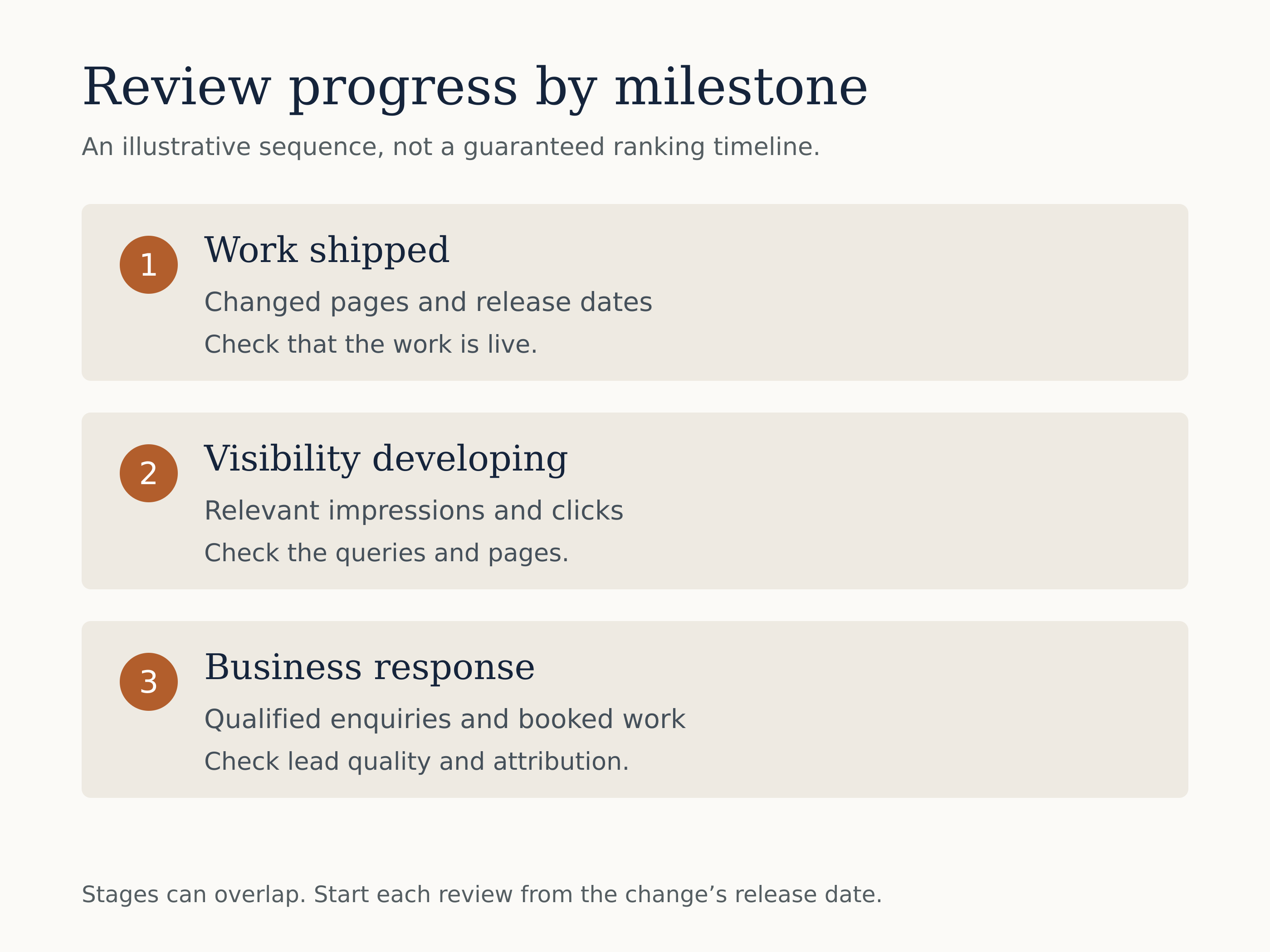
I recommend reviewing SEO progress in three stages: work shipped, visibility developing, and business response. This helps you see what has been completed, whether the right people are finding your pages, and whether that attention is turning into enquiries. The stages can overlap.
| Milestone | Evidence to request | What it does not prove |
|---|---|---|
| Work shipped | Changed URLs, launch dates, tested fixes and working enquiry tracking | That Google has processed the changes |
| Visibility developing | Relevant query impressions and clicks reaching priority pages | That those visitors became customers |
| Business response | Qualified enquiries and booked work, with attribution limits recorded | That every sale was caused by SEO |
Use the date a change went live as the starting point for its review. A page approved this week has not had three months to perform simply because the contract began three months ago. Conversely, an agency cannot treat a long approval delay as if it were search-engine processing time.
Agree on review appointments such as the end of months one, three, and six, but treat those as management checkpoints. They are not dates by which Google owes you a ranking. At each appointment, identify what changed, what the evidence says, and what decision follows.
If you need the implementation sequence behind those milestones, use the 90-day SEO planning guide. The plan organizes the work; the milestone review helps you judge what that work is producing.
Why does SEO take longer for some businesses?
SEO takes longer when important prerequisites are missing or when the business is competing for difficult searches. Implementation capacity also matters: an unshipped recommendation cannot improve a page. Separate those controllable delays from uncertainty about how search performance will develop.
- Website readiness: important pages may be missing, difficult to access, or excluded from indexing. Indexing means a search engine has added a page to its searchable collection.
- Search intent: the page may answer a different question from the one prospective customers are asking.
- Competition and credibility: established providers may offer stronger information, recognized expertise, and more evidence to help customers choose.
- Execution: approvals, development work, photographs, and service information may all depend on someone outside the SEO team.
- Demand and sales process: seasonal interest, service area, pricing, and response time affect whether a visit becomes a useful enquiry.
Consider two hypothetical plumbing businesses. One has an accessible drain-cleaning page that needs clearer scope and a working booking form. The other has only a homepage and cannot yet supply accurate service information. The first can implement a focused improvement; the second must build the resource before evaluating its search performance.
For eligible local businesses, Google’s local ranking guidance also identifies relevance, distance, and prominence as important factors. More work on your website does not remove the distance between your business and a searcher. Track local visibility separately from your website’s organic search visits.
How can you tell whether SEO is working early on?
Early progress is more credible when it connects an implemented change with relevant search activity. Start with priority pages and the queries they serve. A sitewide traffic increase can conceal the fact that the service you want to sell is getting no more attention.
Google’s Search Console guidance explains how to inspect indexing and review performance by query and page. An impression records an appearance in search results; a click records a visit from those results. Neither establishes that someone contacted your business.
- Check whether the intended pages can be indexed and whether Google has discovered them.
- Compare equivalent reporting periods and note seasonality or other marketing activity.
- Separate searches for your business name from searches for the service itself.
- Review qualified enquiries alongside clicks, and test that forms and phone tracking work.
- Record low sample sizes instead of treating a handful of visits as a reliable trend.
My recommendation is to use a one-page monthly review: priority URL, change date, relevant query trend, enquiries, and next action. If impressions increase while clicks remain flat, inspect the actual queries before rewriting everything. If suitable visitors arrive but nobody contacts you, check the offer and enquiry journey as well as the content.
For practical checks on access and indexing, start with the small business technical SEO checklist. A technical report is useful when it identifies a real obstacle and confirms the fix, not simply when its score improves.
When should you question the timeline or change the plan?
Question the plan when progress cannot be explained with evidence, commitments repeatedly slip, or reporting avoids your business goals. Lack of immediate leads alone does not establish failure. Repeated claims that SEO needs more time, without a diagnosis or a next step, are not an adequate review either.
- Confirm delivery. Which promised changes are live, and when were they released?
- Locate the constraint. Is the problem discovery, relevant visibility, clicks, or converting visits into enquiries?
- Check the explanation. What evidence supports the diagnosis, and what alternative explanation was considered?
- Agree on a response. Name the next change, owner, review date, and evidence that would justify continuing or changing direction.
Google’s advice on hiring an SEO recommends asking about expected results, timeframes, and how success will be measured. Google also warns against guaranteed first-place rankings. An estimate is more useful when it states assumptions and dependencies than when it offers a confident date with no supporting explanation.
If you need help establishing those expectations, review my SEO services for small businesses and discuss your SEO priorities. Bring your important service pages, the work already completed, and the outcome you need. That creates a better starting point than choosing a package based only on its duration.
Common questions about SEO timelines
Can SEO produce results in 30 days?
A focused improvement may produce an early signal within 30 days, but that is not a dependable deadline for rankings or revenue. Define the result first. Fixing a broken form can improve the enquiry journey immediately, while whether search visibility changes requires separate evidence and enough observation time.
Will paying for Google Ads make SEO work faster?
Paying for Google Ads does not improve your organic rankings. Advertising can be a separate way to reach prospective customers while SEO work develops. Keep the budgets and reporting distinct so paid enquiries are not presented as proof of organic search improvement.
Does a bigger SEO budget guarantee faster results?
A bigger budget can fund more useful work and remove implementation bottlenecks. It cannot guarantee when Google will reflect changes or when customers will enquire. Ask what additional work the budget buys, who will deliver it, and whether that work addresses the constraint already identified for your business.
Should I stop SEO once rankings improve?
Improved rankings are a reason to review priorities, not automatically to stop all maintenance or keep buying the same work. Protect accurate service information, functioning pages, and reliable measurement. Decide what ongoing work is justified by customer needs, site changes, competition, and the value of the enquiries you receive.
What should you agree on before starting SEO?
Agree on the outcome, starting evidence, delivery responsibilities, and review process before committing to a timeline. Choose one priority service and ask how the proposed work helps customers discover, evaluate, and contact you. A clear plan should make uncertainty visible without using it to excuse unfinished work.
If your concern is specifically how AI assistants mention or cite your business, the AI Visibility Audit addresses a different diagnostic question. It should not be treated as a promise of faster Google rankings. For this SEO timeline question, the appropriate next step is a discussion of your website’s starting point and business priorities.
About the author
Muhammad Faheem is the founder of Shayan Faheem SEO and an SEO & AI Search Specialist with more than 10 years of experience. He works with local service and multi-location businesses, connecting search strategy, content, and website implementation. His full name is Muhammad Shayan Faheem.
PUT IT INTO PRACTICE
Know where your business stands.
The AI Visibility Audit turns a defined set of customer questions into a practical improvement roadmap.
YOUR NEXT CHAPTER